
Abstract
Spanish is my native language.
Because of that, similarities between Romance languages have always felt natural to me.
When I hear Portuguese or Italian, I often recognize words, meanings, or patterns even though I have never formally studied those languages.
Years later, while helping my daughter practice languages, I found myself revisiting those same observations from a different perspective.
She speaks English fluently, practices Spanish at home, and began learning French at school.
While helping her with French vocabulary, I often found myself saying:
“That word is similar to the Spanish one.”
Or:
“I’ve seen that word before in another language.”
This led me to a simple question:
Could collecting and exploring these similarities help learners recognize patterns that might otherwise remain hidden?
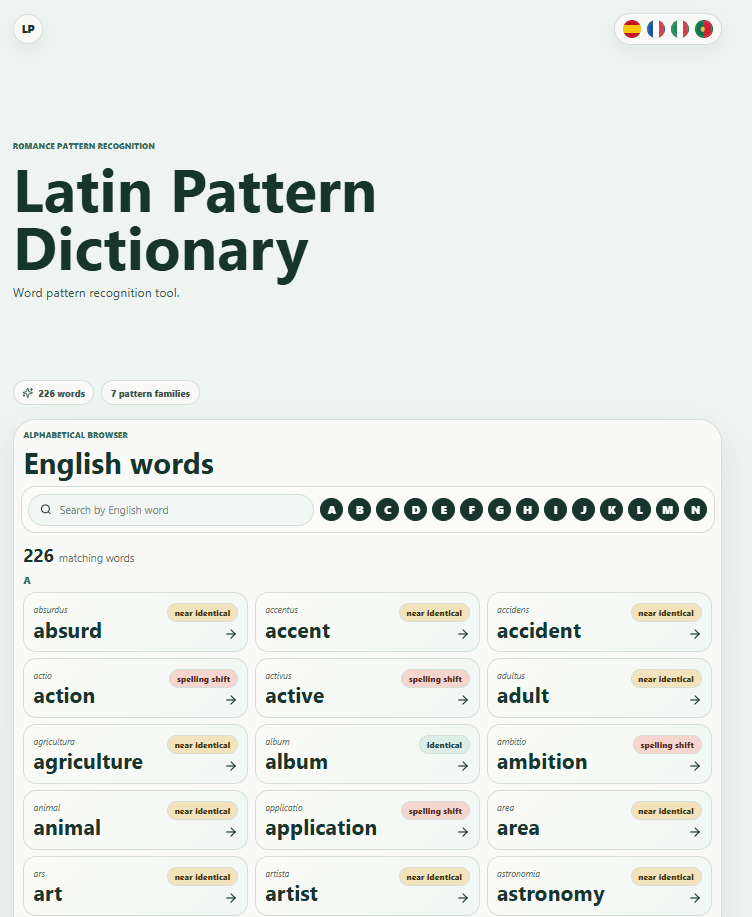
Latin Pattern Dictionary is an experiment built around that question.
Observation
Most language learning focuses on a single language at a time.
Many words belong to larger families that extend across multiple languages.
As a Spanish speaker, these relationships often feel obvious.
A word in French, Portuguese, or Italian may appear unfamiliar at first glance, but after a moment the connection becomes visible.
The observation itself was not new.
What felt interesting was the possibility of making those relationships visible to someone who had not yet developed that intuition.
Could a learner benefit from seeing related words grouped together rather than encountering them separately through different language courses?
Question
What happens when language learners are encouraged to observe patterns rather than memorize isolated words?
Does seeing a word as part of a larger linguistic family change the way we experience language learning?
Experiment
The first version of the experiment was simple. I created collections of phrases in English, Spanish, and French to help highlight similarities between languages.
Over time, the experiment evolved.
Instead of focusing on phrases, I became interested in collecting individual words that shared strong similarities across Romance languages.
Using AI, I began building a collection of words that were approximately 95–100% similar across languages.
The collection was organized from A to Z words and expanded to include:
- Spanish
- French
- Italian
- Portuguese
As the collection grew, another layer emerged.
Many of these words could be traced back to a common Latin origin.
Adding the Latin root transformed the experience from a simple vocabulary comparison into a broader exploration of language evolution.
Instead of viewing a word in isolation, users could browse:
- the Spanish form
- the French form
- the Italian form
- the Portuguese form
- the Latin root
The experiment became an attempt to make relationships visible.
Example
A learner encounters the following words:
- animal
- animal
- animale
- animal
Although the languages differ, the underlying pattern remains visible.
The learner is recognizing a relationship.
The same observation repeats itself hundreds of times throughout the dictionary.
Eventually a larger question emerges:
How much of a language is truly unfamiliar, and how much is already partially recognizable?
Current State
Today, the Latin Pattern Dictionary App contains a collection of highly similar words organized into a searchable reference. It focuses only on visible patterns and relationships.
Future Direction
The current version of the Latin Pattern Dictionary App focuses primarily on visual recognition.
Users can browse related words and explore similarities across languages.
However, written words represent only part of the pattern.
The next version of the experiment will explore sound.
Future releases may include audio pronunciations for each entry, allowing users to hear:
- Spanish
- French
- Italian
- Portuguese
- Latin (the root)
Rather than simply comparing spellings, users would be able to listen to how a word evolved across languages.
The goal is exploration.
By combining visual patterns, historical roots, and spoken language, the experiment may provide a richer way of experiencing how languages are connected.
Reflection
Latin Pattern Dictionary App does not attempt to make someone fluent. It does not replace formal language study. It does not promise faster learning.
Instead, it explores a narrower question:
Can observing similarities across related languages help reveal patterns that might otherwise remain hidden?
At the moment, I do not know the answer.
That uncertainty is precisely why the experiment exists.
For now, Latin Pattern Dictionary remains a small laboratory artifact — an attempt to explore how recognition, curiosity, and pattern discovery influence the way we approach language.
 av slices
Leave a comment