
Abstract
While watching children navigate emotions, I noticed something that kept repeating itself.
A difficult feeling would appear, frustration, embarrassment, disappointment, nervousness, curiosity, and a conversation would follow. The conversation might be helpful, but it was often brief. A few hours later, or a few days later, the feeling was still there.
At the same time, I noticed that many of these moments were already happening around screens. Tablets had become part of everyday life.
This led me to a simple question:
Could a tablet be used as a quiet place for reflection?
Thinking Stories is an experiment built around that question.
Observation
Many emotional experiences are not problems to solve.
They are experiences to sit with.
As adults, we often respond to a child’s feelings by explaining, reassuring, or advising. Sometimes that is exactly what is needed. Yet I began wondering whether there might also be value in simply presenting a feeling from several different angles and allowing the child to think about it independently.
Not because the child should be alone with their feelings.
Not because conversations with parents are unimportant.
But because some reflections happen privately.
Question
What happens when a child is presented with exactly three ways of thinking about a feeling?
Would three perspectives create enough variety to encourage reflection while remaining simple enough not to overwhelm?
Experiment
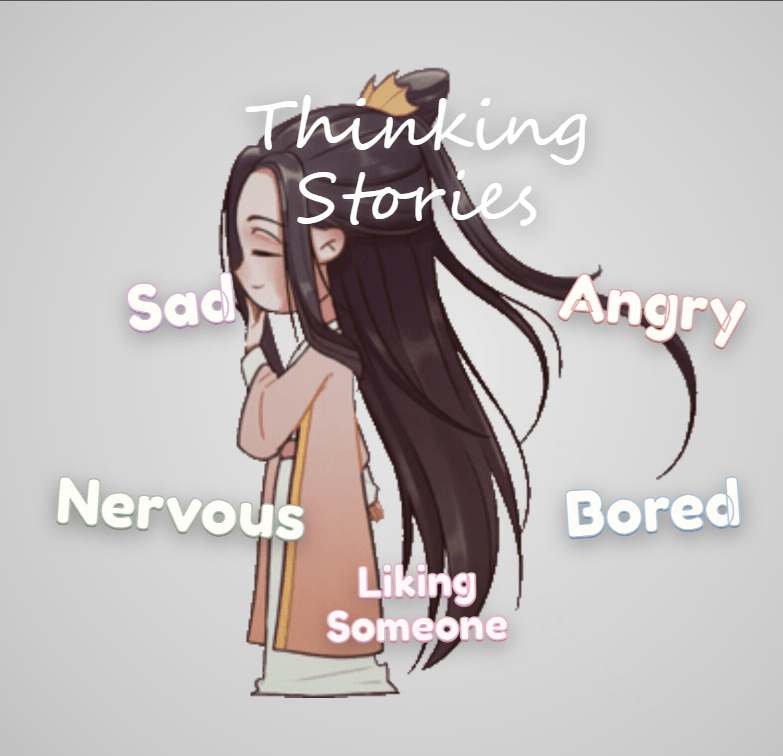
Thinking Stories presents a child with an emotional situation and then offers exactly three perspectives.
There is no correct answer.
The child is not told what to think.
The experiment is simply an invitation to consider a feeling from three viewpoints.
The choice of three perspectives is deliberate. One perspective might validate the feeling. Another might challenge an assumption. A third might offer a different path forward.
The goal is reflection.
Example: “I Lost a Game”
A child loses a game and feels angry.
The application presents three perspectives:
A
I feel angry because I wanted to win.
This perspective simply acknowledges the feeling.
B
Losing does not mean I am bad at everything. It means this game ended this way.
This perspective separates a single event from personal identity.
C
I can pause, let my body calm down, and decide if I want to try again.
This perspective focuses on the next decision rather than the loss itself.
Current State
Today, Thinking Stories App contains a small collection of manually created scenarios drawn from observations and experiences.
Each follows the same structure:
- a situation
- a feeling
- three perspectives
Future Direction
One of the next questions I want to explore is whether the stories should remain fixed or become dynamic.
A future version may allow a child to enter a situation in their own words.
An AI system/database could then generate exactly three perspectives for the feeling in the scenario.
However, the underlying principle would remain unchanged:
- three perspectives
- no correct answer
- reflection rather than instruction
Parents would remain responsible for approving or curating content, ensuring that the child encounters perspectives the family considers appropriate.
Reflection
Thinking Stories does not attempt to replace conversations between parents and children.
It does not attempt to teach a lesson.
It does not attempt to provide answers.
Instead, it explores a narrower question:
Can three perspectives create a useful space for reflection?
At the moment, I do not know the answer.
That uncertainty is precisely why the experiment exists.
For now, Thinking Stories remains a small laboratory artifact, an attempt to transform an observation into something tangible and explore what happens next.
 av slices
Leave a comment